The festival calendar at Baba Garibnath Temple is what brings the dham truly to life. While the daily rhythm of darshan and aarti is its quiet heartbeat, it is on the great festival days — Mahashivratri above all, but also the Mondays of Shravan, the Pradosh days, and the annual fair commemorating the founding of the shrine — that the temple seems to remember its full thousand-fold purpose. On those days the lamps are lit by the hundred, the bells do not stop, the langar serves food into the night, and devotees from a hundred surrounding villages, and from cities far beyond, gather under the 31-foot Shiva to worship together. This page describes each of these festivals — when it falls, what is done, what to expect, and how to participate.
Mahashivratri — The Greatest Night of the Year
Of all the festivals observed at Baba Garibnath ji's dham, none compares with Mahashivratri — "the great night of Shiva." Falling each year on the fourteenth day of the dark fortnight of the Hindu lunar month of Phalguna (corresponding to late February or March in the Gregorian calendar), Mahashivratri is the most important festival in the entire annual cycle of Shiva worship across India. At Baba Garibnath ji's dham, where Mahadev is venerated above all other forms, it is the single holiest night of the year.
The Spiritual Significance
Many traditions explain why Mahashivratri is so sacred. According to one of the most cherished, this is the night when Lord Shiva performed the cosmic dance of tandava — the dance of creation, preservation and dissolution. According to another, it is the night of Shiva and Parvati's wedding. According to yet another, it is the night when Shiva swallowed the deadly halahala poison that emerged from the churning of the cosmic ocean, saving the universe and turning his throat blue (hence his name Neelkanth, the blue-throated). All three traditions are remembered and celebrated at the dham.
For the practising devotee, Mahashivratri is the one night of the year when the fast and vigil of jaagran (staying awake all night in worship) is most highly recommended. Tradition holds that prayers offered on this night carry many times the spiritual weight of prayers offered on any ordinary day.
The Schedule at Baba Garibnath Temple
The temple opens for the Mahashivratri vigil on the eve of the festival and remains open throughout the entire night. Darshan continues unbroken until sunrise the next day. The night is divided into four prahar — four watches of approximately three hours each — and a special puja is performed at the start of each:
- First Prahar (sunset to ~9:30 PM): Abhishek with milk, followed by aarti.
- Second Prahar (~9:30 PM to ~12:30 AM): Abhishek with curd, followed by aarti.
- Third Prahar (~12:30 AM to ~3:30 AM): Abhishek with ghee, followed by aarti — this is widely considered the most powerful watch of the night.
- Fourth Prahar (~3:30 AM to sunrise): Abhishek with honey and water, followed by the great Brahma-muhurta aarti at first light.
Throughout the night, devotional chanting of "Om Namah Shivaya" and the Shiv Tandava Stotra continues without break. Local bhajan-mandalis from villages across the district take turns leading the kirtan. The 31-foot Shiva statue is lit with hundreds of lamps. Young men and women in saffron and white sit cross-legged on the courtyard, eyes closed, chanting in unison. Older sevaks tend the Akhand Dhuna ceaselessly. The atmosphere — by about 2:00 AM, when the cold settles in and the chanting has thickened — is something one does not easily forget.
The Mahashivratri Mela
Surrounding the spiritual core of Mahashivratri is the mela — the great fair that turns the temple grounds and the road approaching them into a temporary township. Stalls of religious goods, sweets, cloth, and toys are set up by traders from the surrounding villages. Free langar is served continuously throughout the day and night. Devotees come from Una, Hamirpur, Bilaspur, Kangra; from Punjab cities like Hoshiarpur, Jalandhar, Ludhiana; and from as far as Delhi and Chandigarh. By the morning of the festival, several thousand visitors will have passed through the dham.
Practical tips for visiting on Mahashivratri:
- Arrive early. If you wish to have an unhurried darshan, arrive by 6:00 AM on the day of the festival. The temple grounds will already be crowded by then but the longest queues form by mid-morning.
- Stay overnight. The most atmospheric experience is the night vigil. The temple's dharmshala fills very quickly; book in advance, or arrange accommodation in Una town and travel back at dusk.
- Dress warmly. February-March nights at the temple are cold; bring a shawl or jacket for the night vigil.
- Eat from the langar. The food is excellent and the seva is part of the festival's spirit.
- Carry your own water bottle and a small flashlight.
- Public transport is augmented; HRTC runs special buses from Una bus stand to the temple throughout the day and into the night.
The Holy Month of Shravan
Second only to Mahashivratri in importance is the Shravan month — the fifth month of the Hindu calendar, falling in July-August by the Gregorian reckoning. Shravan is sacred to Lord Shiva for the entire month, and at Baba Garibnath ji's dham it is one of the most active and spiritually charged times of the year.
Throughout Shravan, devotees observe a number of optional disciplines: fasting on Mondays, abstaining from non-vegetarian food, donating to the poor, reading the Shiva Purana, and offering worship to Shiva-linga shrines wherever they can. Many devotees vow to visit Baba Garibnath ji's temple at least once in the month — and many of them choose Mondays in particular.
Sawan ka Somvar — The Mondays of Shravan
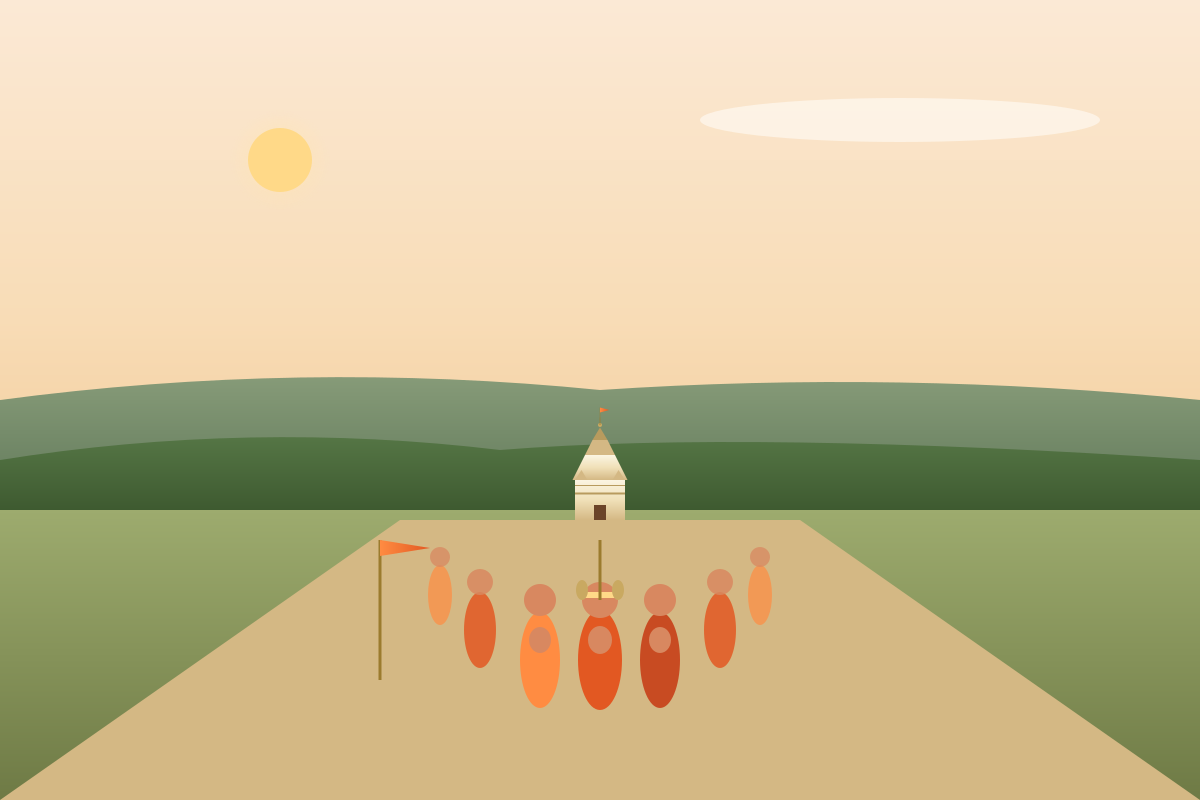
Each Monday of Shravan is a small festival in itself. The temple opens earlier — usually at 4:00 AM. A special Rudrabhishek is performed at 5:30 AM, often booked in advance by family groups. Long queues of devotees, many of them wearing saffron, file into the sanctum to offer water, milk, bel patra, and prayers. Songs and bhajans are sung in the courtyard throughout the day. The langar serves continuously.
The number of Mondays in Shravan varies from year to year — most years there are four, occasionally five. Devotees who wish to make all of them a pilgrimage are warmly welcomed. Many older devotees, having maintained this practice for decades, treat it as one of the deepest disciplines of their spiritual life.
Pradosh Vrat — The Twice-a-Month Observance
Twice each lunar month — on the thirteenth lunar day (trayodashi) of both the bright and the dark fortnight — falls Pradosh, a particularly auspicious day for the worship of Lord Shiva. The evening hours of Pradosh, between sunset and the start of the night, are believed to be a window of special grace.
At Baba Garibnath ji's dham, Pradosh is observed with a particularly elaborate Sandhya Aarti, an extended Rudrabhishek if devotees have requested it, and special chanting of the Mahamrityunjay Mantra. Devotees who fast on this day (consuming only water or fruit until evening) traditionally break their fast after the sunset aarti at the temple.
Pradosh that coincides with a Monday or Saturday — known as Soma Pradosh or Shani Pradosh — is considered especially powerful. Such days draw additional devotees and are marked at the temple with a longer aarti and additional chanting.
The Annual Sthapana Mela (Founding Day Fair)
An annual fair commemorating the establishment of the shrine is held at the temple each year. The exact date varies and is announced by the temple administration, traditionally falling in the autumn months. The fair is smaller in scale than Mahashivratri but carries its own warm and intimate character. Local devotees, traders, and folk-singers converge for two or three days of bhajan, kirtan, langar, and small cultural programmes. Schoolchildren from nearby villages perform short devotional plays. Old sevaks share stories about the saint and the temple's history. The langar runs uninterrupted.
For devotees who wish to experience the temple at its most local and most heartfelt — without the larger crowds of Mahashivratri or the intense pace of Shravan — the annual fair is the best choice.
Other Observances Throughout the Year
Maha Aarti on Special Days
Beyond the major festivals, the temple holds Maha Aarti — an elaborated, longer-than-usual aarti — on a number of additional days through the year. These include:
- Guru Purnima (full moon of Ashadha, June-July) — honouring all gurus, including Baba Garibnath ji and his guru Bhagwan Dattatreya.
- Shivratri (Masik) — the monthly Shivratri, on the fourteenth lunar day of every dark fortnight.
- Kartik Purnima (full moon of Kartik, October-November) — a particularly auspicious day for lamp-offerings.
- Datta Jayanti (Margashirsha Purnima, November-December) — honouring the birth of Bhagwan Dattatreya, Baba Garibnath ji's guru.
Navratri (Ashvin and Chaitra)
Although the temple is principally a Shiva-centric shrine, the nine nights of Navratri (twice a year) are observed with respect, in keeping with the broader Hindu tradition of the region. A special evening aarti is held on each night, and the temple's connection to nearby Mata Chintpurni Devi shrine (40 km away) means many devotees combine the two visits during this period.
Diwali
The temple is illuminated with thousands of small clay lamps on Diwali night. The visual effect — lamps reflecting on the still surface of the lake at dusk — is one of the temple's most beautiful sights of the year. The aarti on Diwali night is followed by the distribution of sweets and light refreshments to all visitors.
Seasonal Highlights
The Monsoon Lake-Darshan (July-September)
While not a "festival" in the strict sense, the months when the temple sits in the midst of a high-water Govind Sagar are an experience that thousands of devotees specifically time their pilgrimage to. The boat ride out to the temple, the lap of water against the lower walls of the sanctum, the soft mist that hangs over the reservoir at dawn — all of this combines into something that, by its own quiet logic, makes the visit feel like a small festival of its own.
A Note on Crowds and Calm
Each devotee brings a different need to the dham. Some seek the throbbing collective energy of a major festival night — the chanting, the lamps, the throng of folded hands. Others seek the deep, almost wordless quiet of a weekday morning when only a handful of regulars are present. Both are valid; both are blessed. If you have the option, plan one visit of each kind in the course of your devotion to Baba Garibnath ji. Each will give you something the other cannot.
॥ हर हर महादेव ॥ जय बाबा गरीब नाथ ॥