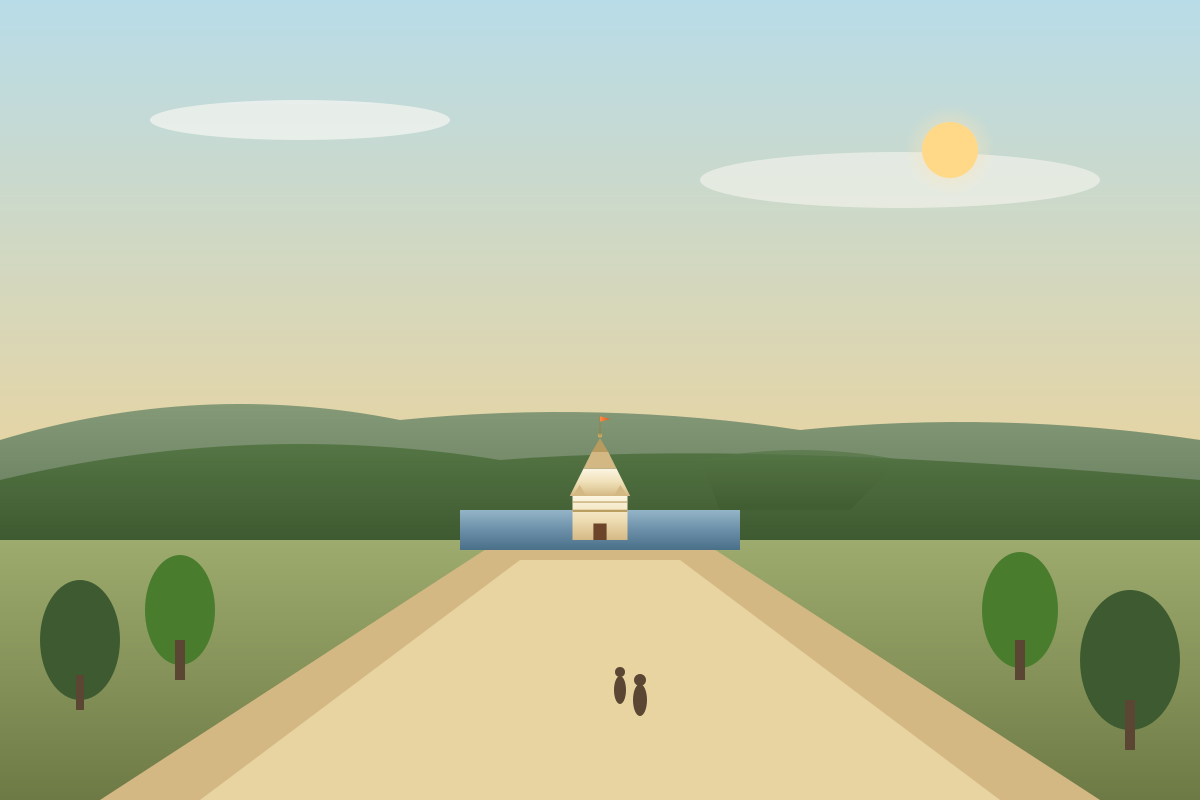
A five-hundred-year-old tapasthali on the shore of Govind Sagar Lake — where one of the eighty-four Siddhas meditated, where an Akhand Dhuna has burned for centuries, and where countless devotees have found their faith renewed.
Tucked beside the gentle expanse of Govind Sagar Lake, near the village of Andrauli in the Raipur Bangana subdivision of Una district, stands a temple that quietly holds five centuries of devotion. Baba Garibnath Temple — also written as Baba Garib Nath Mandir or Sidh Baba Garibnath — is unlike any other shrine in Himachal Pradesh. For most of the year it sits in a green meadow flanked by Shivalik hills. Then the monsoon arrives, the Sutlej swells, and the very lake created by the Bhakra Dam in the 1960s rises to embrace the temple. For two to three months every rainy season, devotees reach Baba ji by boat, gliding over still waters that lap the lower floor of the sanctum. Few sights in the whole pilgrimage circuit of north India match it.
Yet the visual drama is only the outer skin of this place. The soul of the temple is Siddha Baba Garibnath ji — one of the eighty-four Siddhas said to have taken birth on the same auspicious day as Sage Vyasa's son Shukdev. A disciple of Lord Dattatreya, he chose this then-forested grove on the banks of the river to perform forty long years of austere penance under an Amaltas (laburnum) tree that, remarkably, still grows on the temple grounds today. When local cowherds first saw a strange luminous glow flickering in the bushes, they ventured close and discovered the saint absorbed in dhyana. He revealed himself, blessed the gathering, and promised that any devotee who prayed sincerely at this spot would never leave empty-handed. That promise has held for half a millennium.
Today the temple complex is at once an active spiritual centre, a heritage site, and a quiet pilgrimage retreat. The 31-foot statue of Lord Shiva rising above the shrine has become an iconic image of Una district — visible from distant hills, from the Bhakra-Naina Devi road, and from boats out on Govind Sagar. Beneath it, in the inner sanctum, the idol of Baba Garibnath ji presides serenely, as does the Akhand Dhuna — the eternal sacred fire which has, by oral tradition, never been allowed to die out. The bhabhuti (sacred ash) gathered from this fire is what miraculously cured the temple's most famous twentieth-century caretaker, Baba Naseeb Singh ji, when no medicine could.
Local memory in the villages around Raipur Maidan still preserves the moment of the temple's beginning. It was the late fifteenth century. The Sutlej ran wild through this region long before any dam tamed it. A patch of forest near the river was thick with amaltas, neem and pipal — and one summer evening, villagers chasing a stray cow noticed an unearthly glow within the foliage. They expected fire. They found silence. A saint, motionless, eyes closed, face radiant in the dusk light, sat cross-legged at the foot of an amaltas tree.
That was Sidh Baba Garibnath ji. Some say he had already meditated there for forty years before the villagers found him. He spoke gently to the gathering, told them his lineage flowed from Lord Dattatreya, and said this was a place where the prayers of even the poorest — the garib — would always reach Mahadev. From that vow comes his name: Garib-Nath, the Lord of the Poor.
The original tree still stands today on the temple grounds. After Bhakra Dam was completed and the surrounding forest disappeared beneath the water of Govind Sagar in the 1960s, this single laburnum and the temple beside it remained the lone witnesses of what once was. Read the full history of the temple ›
From the first sound of the morning bell to the lamps of the evening aarti, every hour at Baba Garibnath ji's dham is a quiet invitation to step away from the noise of the world.
From the soft Mangla Aarti at first light through the resonant Sandhya Aarti at sunset — six aartis daily punctuate the rhythm of worship. Sit in the temple courtyard, hear the bells echo across the lake, and let stillness do its work.
During monsoon — usually July through September — the lake rises and surrounds the temple from every side. Devotees row out by hand-paddled boats to offer their prayers; an experience as unforgettable as it is rare anywhere in India.
The eternal sacred fire — said to have burned uninterrupted for centuries — is the heart of the dham. The bhabhuti (sacred ash) collected from it is offered to devotees and is believed to carry the healing grace of Baba ji himself.
In the spirit of the temple's founding name — Garib-Nath, the Lord of the Poor — a free langar serves wholesome meals to every visitor without distinction of caste, faith, or means. Volunteer-driven, donor-supported, open to all.
Every morning a special prayer known as Garib Vani — the voice of the humble — is recited in the temple. Devotees join in chants asking that no one be turned away from the door of the divine, ever.
The greatest festival of the year. On the night of Maha-Shivratri, thousands gather under the lamp-lit 31-foot Shiva. The whole night is filled with bhajan, rudrabhishek, and the great ringing of conches. Read more on our festivals page.
Devotees who walk in here for the first time often say the same thing afterwards — "there is something different about this place." What that something is, no two people answer alike. For some, it's the unbroken silence at five in the morning, before any human sound has begun, when only the lapping of the lake against stone can be heard. For others, it's the warmth of the bhabhuti placed in the palm by a temple sevak who has done nothing else for thirty years. For many, it's simply that here, even the most ordinary prayer feels heard.
The temple is one of the prominent stops on the religious circuit of Himachal Pradesh's Una district — a region the Sikh tradition calls "Unnati", the place of progress, named so by the fifth Guru, Sri Guru Arjan Dev ji, in respect for the diligent character of its people. Within a small radius, devotees can also visit Shri Mata Chintpurni Devi (40 km away), Naina Devi across the dam in Bilaspur, Shiv Bari in Una town, and the historic Dera Baba Bharbhag Singh Gurudwara. But Baba Garibnath stands apart — partly for its setting, partly for its lineage, and partly for the simple, plain, almost rustic faith of those who tend it.
When Baba Garibnath ji first revealed himself to the villagers, he made a promise: "At this place, no devotee — no matter how poor, no matter how lost — will ever be turned away." Five hundred years on, that promise is still the working principle of this temple. The langar, the free shelter for pilgrims, the medical camps held during festival weeks — all of these flow from that single sentence spoken under the laburnum tree.
Whether you are coming with a wish in your heart, a sorrow you can no longer carry, or simply a wish to sit a while in a place where centuries of prayer have soaked into the very stones — Baba ji's door is open. It always has been. May this small website help you find your way to the dham, and may your visit, when you make it, be more than a tourist's stop.
॥ बाबा गरीब नाथ जी की जय ॥

From Delhi, Chandigarh, Pathankot, or anywhere in Punjab and Himachal — reaching Una and the temple is straightforward. Our travel guide covers every route.
View Travel Routes